Johns Hopkins
- Feb 1, 2023
- 6 min read
Saturday, January 28, 2022 @ 2:00 PM Baltimore, MD
Goldfarb Gymnasium

via Wikimedia
THE SCHOOL

The Johns Hopkins University is a private research university in Baltimore, Maryland. In his will, entrepreneur, philanthropist, and Baltimore resident Johns Hopkins left $7 million toward the construction of a university. JHU was officially established in 1876. With about 6,000 undergrads and 20,000 grad students, Johns Hopkins is the largest private university in Maryland. Never listen to college rankings because they’re all made up, but US News ranks Hopkins as the seventh-best university in the United States.
The Blue Jays compete in the Centennial Conference in NCAA Division III in every sport except lacrosse, where they play in the Big Ten. As you can probably guess, JHU has a lacrosse-focused athletic department. The Blue Jays have been to a record 18 D-I men’s lacrosse championship games, winning 9 (though they had one of their worst seasons in 2022).
Swarthmore University is a private liberal arts college in Swarthmore, Pennsylvania, just outside of Philadelphia. It can be pronounced SWARTH-more or SWATH-more depending on how much of a Philly accent you have. The Garnet and the Blue Jays have ruled the Centennial Conference recently. They have combined to win the conference title each of the last five years, and have faced off in the conference championship game in the past four tournaments, with Hopkins winning three. There’s no change this season; they are the top two teams in the Centennial and both are ranked in the top twelve of the D-III poll.
THE TOWN
Johns Hopkins’s main campus (referred to as the Homewood Campus after the estate house that stood there) is in the Charles Village neighborhood in North Baltimore. Like pretty much all of the rest of Baltimore, rowhouses line the streets in most places around campus. As with any large university, there are also cheaply made apartment buildings and fast casual restaurants immediately surrounding Homewood. From Capitol Hill in DC, it takes one hour to arrive by car.

The Baltimore Museum of Art is located on the campus of Johns Hopkins. I had a little extra time before the game started, so I stopped by. The museum has a wide array, ranging from ancient Middle Eastern to 18th-century European to contemporary American art, with a little bit of everything in between. Since I only had an hour to visit, I had to do a speedrun of the museum, but there’s enough there to spend most of a day.
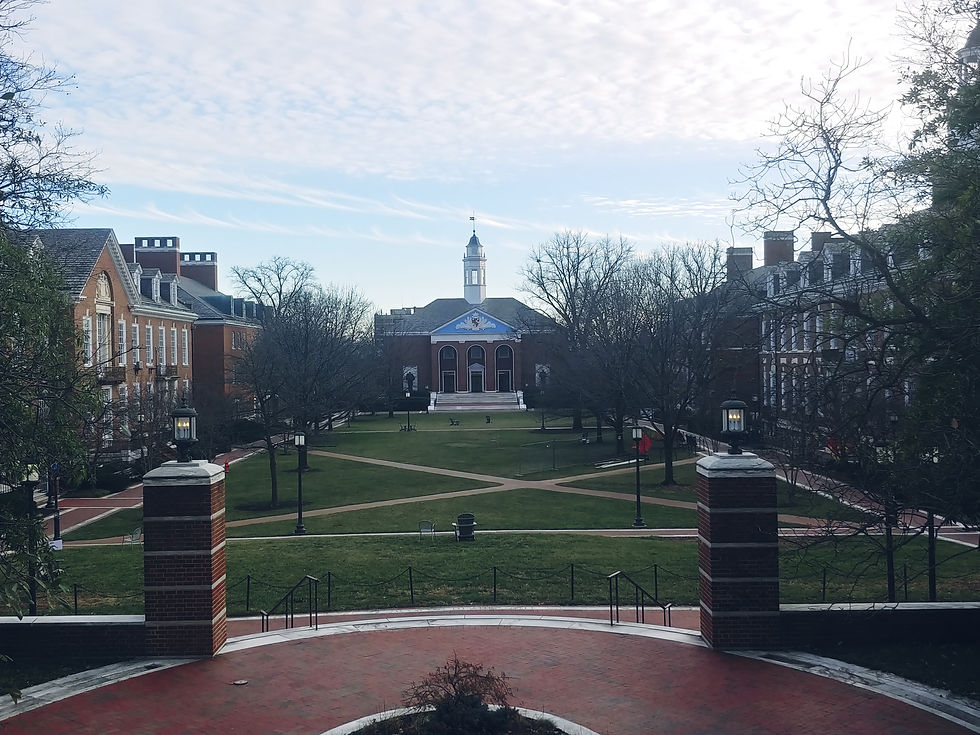
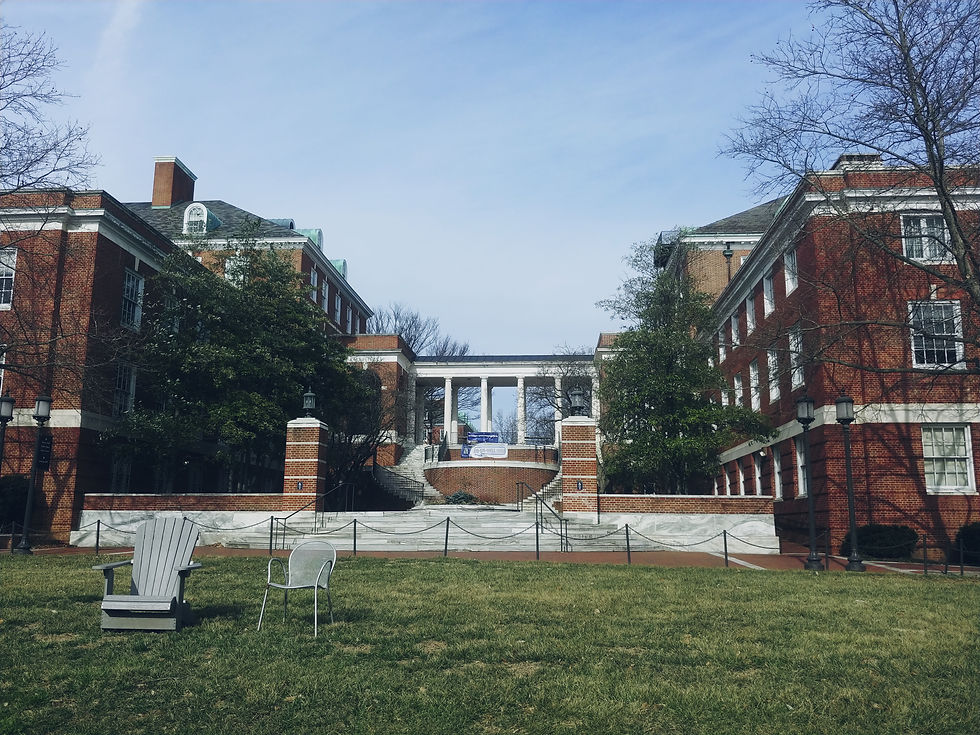
At 140 acres, JHU’s campus is pretty sizable for an urban university. Unlike George Washington University last week, there’s a clear line between Johns Hopkins and surrounding Baltimore. As you’d expect, there are a lot of large green spaces and stately brick buildings. There was a large student presence for a Saturday; the libraries seemed busy. Baltimore is hilly, and that’s extra true for Johns Hopkins. My phone tells me I walked about 10,000 steps on Saturday, but it felt like more.

Goldfarb Gymnasium is teeny-tiny. There are seven rows of seating on one side, five rows on the other, and some temporary bleachers on one baseline. They claim they can fit 1,100 people inside, but that would be tight. A positive of small gyms, though, is you don’t need many people to make it feel full. The official attendance for this game was 500 (though I suspect it may have actually been more) and that felt like a packed house. There’s nothing necessarily special about Goldfarb, but I’ll take a packed small gym over a mostly-empty bigger one any day.

THE GAME
After visiting the art museum, I got a falafel wrap just off-campus and walked over to the basketball gym. Attendance is free; Johns Hopkins probably doesn’t need the money. I sat on the opposite side of the gym from most Blue Jay fans, as it was already getting crowded fifteen minutes prior to tipoff.

The lobby of the Newton White Athletic Center (which houses Goldfarb Gymnasium) doubles as a trophy room. All throughout the room, they display various awards given to pretty much every sport they sponsor (including men’s and women’s fencing). The best spot is given to a large case devoted to their current champions. Hopkins is the reigning NCAA champion in women’s cross country and women’s soccer, and they are runners-up in men’s swimming and women’s field hockey. This is impressive (though if you’d like to be cynical, Johns Hopkins has a larger enrollment and a larger budget than most Division III schools, so it should be expected that they excel athletically).
In my last write-up, I wrote about the lively fan environment between George Washington and Dayton. There was another great setting for this one. JHU had a healthy contingent of students, families, and locals. Swarthmore brought a lot of fans as well, seemingly not just parents of players. While the Blue Jays certainly had more supporters, Swarthmore’s fans were numerous and vocal enough to have an impact.
Division III PA announcers come in all forms. Sometimes it’s a college student probably doing it for free. Sometimes it’s someone affiliated with the university. Most of the time it’s a middle-aged guy who lives nearby. But this is the first time it’s been a sixty-something year-old man with wispy white hair in a full suit and a bowtie. He did far better than most, keeping up with two rapidly-substituting teams with relative ease. I sat behind him and found him fascinating.
~~
The intensity of the game seemed to get to Johns Hopkins early, as they had two over-and-back turnovers in the first couple of minutes. But they righted themselves and recovered to tie the game 9-9 with 15:23 left after #44, Will Sykes, made a three-point shot. Over the next six minutes or so, the Blue Jays went on a 16-6 run highlighted by an and-one by #15, Sydney Thybulle, and a three by #4, Brian Johansson. With 9:19 in the first, Hopkins led 25-15.
Swarthmore was too good to let this game get away from them. Over the next 2:30, they meticulously got back into the game and tied the score, 26-26, with 6:49 left before the break. For the rest of the half, it was a back-and-forth affair as JHU would take a small lead but the Garnet would immediately cut it or tie it. With 0.8 seconds left, Hopkins inbounded the ball under their own basket with a one-point lead, 36-35. The inbounder passed to #14, Tom Quarry, standing about fifteen feet from the hoop. He tapped the ball toward the basket with one hand, and somehow it fell in. The Blue Jays went to the locker room ahead by three, 38-35.
Halftime entertainment was a free throw shooting contest between a guy in a gorilla suit and a guy in a dog mask. This doesn’t mean anything. I just thought it was worth a mention.
Shortly after the gorilla won, Swarthmore finally took a lead (42-41) after #12, Cal Hanson, made a three. The Garnet pushed to the lead to as many as four at 12:30, but Johns Hopkins controlled the next four minutes. This span was highlighted by a 5-0 individual run by #21, Carson James. With 8:45 left, Hopkins had pushed their lead to 54-49.
Swarthmore had opportunities to cut the lead, but their shots just kept popping out. With four minutes on the clock, JHU’s Quarry hit a three to give the Blue Jays a double-digit lead (65-55) for the first time since the first half. Not long after, Swarthmore was forced to intentionally foul to stay in the game. Johns Hopkins kept missing the ensuing free throws, and with :42 left, Swarthore’s #50, Michael Caprese, made a layup and cut it down to seven, 74-67. But the Garnet missed every shot afterward and could not come back, leading to their first conference loss of the season.
Final: Johns Hopkins 77, Swarthmore 67
~~
If you spend any time in the Newton White Athletic Center, you can’t help but see the names Wall and O’Mahoney everywhere. The lounge is the Wall-O’Mahoney Student-Athlete Lounge. The scoreboards in the gym are dedicated to the memories of Wall and O’Mahoney. Apparently, there is a Wall-O’Mahoney scholarship as well.
Glen Wall and Matt O’Mahoney played basketball at JHU in the eighties. In 2001, both men worked in the World Trade Center, where they lost their lives on September 11. Each year, Johns Hopkins honors Wall and O’Mahoney in one game per year by inviting their families onto the court and giving a player-of-the-game trophy to a member of each team.
Carson James got the award for Johns Hopkins after a 22-point, 8-rebound, 7-assist performance. Swarthmore’s trophy went to Colin Shaw (#35) after scoring 13 points, grabbing 6 rebounds, and showing a noticeable amount of hustle.
This was a touching moment from JHU, particularly after such a hard-fought game. After an hour-and-a-half of overall intensity, it was nice to see the two teams come together and have players from each team be congratulated.
Comments